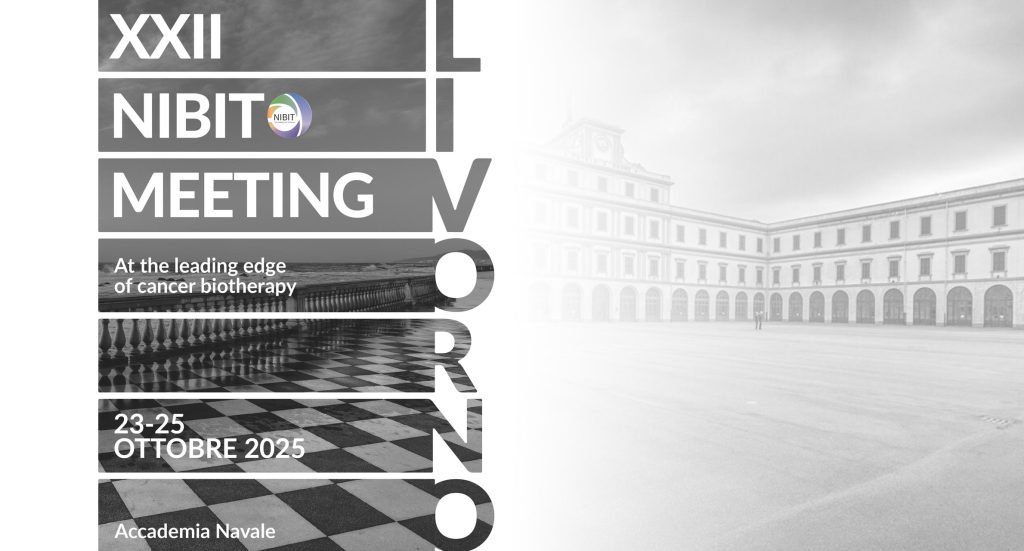
The XXII NIBIT Meeting, scheduled to take placefrom October 23-25, 2025 IN Livorno. The XXII NIBIT Meeting will continue to be at the forefront of cancer immunology and immunotherapy,with a strong focus on clinical advancements across a variety of cancers.
As the field of Tumor Biotherapy continues to evolve, next year’s sessions will highlight cutting-edgedevelopments in human cancers such as non-small cell lung cancer (NSCLC), melanoma, hepatocellular carcinoma, gastrointestinal cancers, and breast cancer. These will include both established and emerging immunotherapy approaches.
Additionally, the meeting will delve into transformative technologies shaping the future of oncology,including AI-driven diagnostics, single-cell analysis, and spatial mapping of tumor microenvironments. These innovations aim to facilitate the development of personalized treatment strategies.
Now at its twenty-second edition, the annual NIBIT Meeting is among the most important scientific events in the field of immuno-oncology in Italy and Europe.
The emphasis on translational medicine, the interaction between clinicians and researchers, the attention to the most innovative research lines, the presence of international researchers, together with a rigorous independence from the industry, are the characteristics that make the NIBIT Meeting an essential event for all professionals (doctors, scientists, industry representatives, research nurses, data managers) involved in research and medicine in oncological immunotherapy.
The event
In addition to the scheduled presentations and abstracts received, we will have the honor of attending the “Pezcoller Lecture” delivered by Marco Colonna, Professor of Pathology & Immunology at Washington University School of Medicine in St. Louis, MO, USA and member of the National Academy of Science.
Dr. Colonna’s research focuses on immunoreceptors. In this field his accomplishments encompass identification and characterization of the Killer cell Ig-like receptors and HLA-C polymorphisms as their inhibitory ligands, as well as the discovery of the LILR and TREM inhibitory and activating receptor families. Through analysis of the cellular distribution of these receptors, he identified plasmacytoid dendritic cells as source of IFN-a/b in anti-viral responses and innate lymphoid cells that produce IL-22 in mucosae. His current areas of research include: 1) Innate lymphoid cells in mucosal immunity. 2) Plasmacytoid dendritic cells in host defense and autoimmunity.3) TREM2 and innate immunoreceptors in Alzheimer’s disease and cancer.
Key themes of the meeting will include:
- AI and Digital Pathology in Personalized Cancer Diagnostics
- New Experimental Models for Translational Research
- Mechanisms and Regulators of Anti-Cancer Immunity
- Clinical Advances in Immunotherapy Across Tumor Types and Cancer Vaccines
- New Targets and the Role of Immunotherapy in Combination with Targeted Therapies
Download scientific program (PDF)
Call for abstract
All participants are encouraged to submit an abstract in English. The abstracts will be reviewed by the Scientific Committee and selected for oral or poster presentation. When submitting the abstract, presenting authors must select one of the following topics:
- Myeloid cells in cancer
- Uncovering the molecular interactions within the tumor microenvironment
- B and T cells in cancer
- AI in immune oncology from research to clinic
- Empowering immune cells for adoptive cell therapy
- Where we are and where we are going
- New targets in immune-oncology
The abstract should respect the following guidelines:
- The abstract must be submitted in English.
- Abstract title should be max 250 characters (spaces included) and should reflect the content of the abstract.
- Commercial names may not be used in the abstract title.
- No more than 10 authors can be listed. Only institutional affiliations, cities and countries should follow. One of the authors must be flagged as “Presenting author”.
- Abstracts should be organized under the headings: Introduction / Methods / Results / Conclusions
- Tables and figures can be uploaded as a separate file (JPG, max 1 page)
- The online abstract submission procedure will not accept abstracts that exceed 500 words
- Abbreviations may be used if standard or if spelled out and defined at the first use. Compounds should be mentioned with the generic name, in lower case. Commercial names are admitted in the text, with an ®, and if in brackets following the generic name, i.e. “generic (Commercial ®)”
Abstract Selection Process
The Scientific Committee will make the selection of abstracts for the oral or poster presentation. Please note that submitting an abstract does not constitute registration for the meeting.
Click here to submit your abstract
Travel grants
NIBIT will offer a limited number of Travel Grants.
The Grant will cover the travel expenses up to the amount of € 500. The reimbursement will be provided by bank transfer after the end of the meeting, upon receipt of flight and/or ground transportation tickets/invoices.
To be eligible you have to:
- Be the presenting author of a submitted abstract
- Be born after 1 November 1985
To apply, please upload a CV or a bio sketch, including your publications, when submitting the abstract. Applications are subject to approval by the Scientific Committee
Registration
| REGISTRATION TYPE Closing at 23.59 on July 23 | |||
| Advance registration | Regular registration | ||
| NIBIT Member – over35 | € 220,00 VAT incl. | € 250,00 VAT incl. | |
| NIBIT Member – under 35 | € 120,00 VAT incl. | € 150,00 VAT incl. | |
| NIBIT Member – Post doc | € 120,00 VAT incl. | € 150,00 VAT incl. | |
| NIBIT Member -PhDStudent | € 120,00 VAT incl. | € 150,00 VAT incl. | |
| NIBIT MemberResident | € 120,00 VAT incl. | € 150,00 VAT incl. | |
| UndergraduateStudent | free of charge | free of charge | |
| Non-member (all categories) | € 320,00 VAT incl. | € 350,00 VAT incl. | |
SOCIAL DINNER € 50,00 VAT included
Open to all registered participants
* NIBIT member with settled payment of membership fee for 2024 and 2025
** Membership fee for 2025 is € 50; to become a member please fill in the form
Livorno
Born of the will of the Medici family who made it a city in 1606, Livorno became an oasis of welcome for all religious, political or racial persecuted, enriching itself with the resourcefulness and customs of the most diverse foreign nations. Bridges, canals, and historic palaces are reflected in the calm waters, making it feel like a little Venice on the Mediterranean.
In the second half of the 16th century, due to the military and commercial strategies of the Medici, it was determined that the fishing village that arose around the Mastio di Matilde di Canossa should become one of the main ports of Europe. In the nineteenth century, it was here that the very first bathing establishments in Europe were built, slowly cultivating the concept of a seaside vacation.
THE NAVAL ACADEMY
An institution of excellence in higher education of the Italian Navy, where tradition and innovation come together to prepare naval officers for the challenges of thesea. Established in 1881, near Terrazza Mascagni, the Academy is a symbol of culture, discipline, and technological advancement where Italian naval history intertwines with the most modern techniques of navigation and military strategy.
The complex, designed by architect Francesco Cantini, extends over an area of over 200,000 square meters, a true nineteenth-century architectural colossus that fascinates visitors and enthusiasts. Inside, the structure houses 58 buildings, used for various operational functions: dormitories, offices, mess halls, classrooms, technological laboratories, navigation simulators, a vast library with a rich heritage of maritime texts, a chapel, 2 harbors, numerous sports facilities, a hospital and even a buried brigantine, all designed to offer officer cadets a complete and stimulating learning experience.
The first-year cadets of the Naval Academy of Livorno, during the summer months are embarked on the Amerigo Vespucci Training Ship, another great pride of the Italian Navy. A sailing ship, universally recognized as the “most beautiful ship in the world”, often moored in the Port of Livorno, which offers cadets the unique opportunity to apply their acquired knowledge in open sea.
How to reach the congress venue
Accademia Navale
Viale Italia, 72
57127 Livorno – Italy
By car
The venue is easily reachable by the Livorno Sud highway exit and continuing towards the coast on Viale Italia.
By plane
Pisa Galileo Galilei Airport is just 27 km away, about a 30-minute drive. A train connection is available as well.
By train
The Livorno Centrale railway station is just 9 km away and a bus service is available. Take bus 1+ directly from Livorno Centrale station to Italia 7 Accademia Navale, a journey of approximately 30 minutes.